
a blog, revisiting past award winners
EveryBestPicture.com revisits this Oscar Best Picture winner
Despite being considered a ‘lost film’ for much of the 20th century this epic silent movie was rediscovered and restored in the 1990’s, and subsequently re-released. Wings was the biggest movie of its day, taking 9 months to put together- much longer than the 1 month generally expected of a shoot. It ran massively over-budget, featured stars of the day (Clara Bow, for whom the phrase “It Girl” was coined) and stars of the future (Gary Cooper). Cast and crew were holed up in an Arizona hotel for the duration, tales of love and lust became Hollywood legend: affairs, engagements and marriages began and ended, few lasted beyond filming. Battles in the air were shot using 300 pilots, special effects abound, many of which were created just for Wings. This movie was made to seize the mainstream by the scruff of the neck and boy, did it succeed. 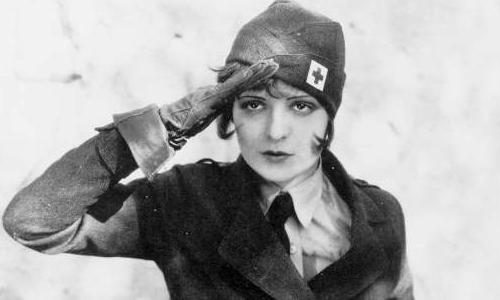 Clara Bow reporting for duty What struck me about this picture was the frank, censor-baiting, sensitivity challenging thread that ran throughout this 90 year old movie: it featured a smattering of male and female nudity, one pilot giving another a passionate kiss on his deathbed and blood-spattered deaths (very rare sights in widely released early movies). A challenging variety of shots and cuts made it a genuinely entertaining watch: big tracking shots, bold triple superimpositions and humungous battle scenes shot from the air. Wings rivalled my experience of watching Citizen Kane for variety, although lacked the confident, steady hand of Orson Welles' masterpiece. 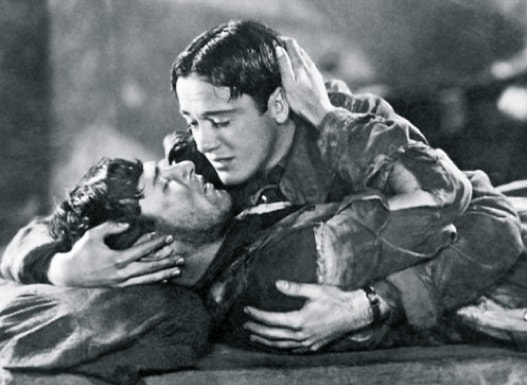 These pals are not afraid to express their love for eachother The first act of the movie shows the three protagonists in their adolescence, barely out of high school (cue lots of “gee-whizz” type dialogue). They bounce around in a love triangle of sorts, a fairly by-the-book set up. With a couple of elaborate (perhaps over-elaborate? Impressive, but distracting) shots such as filming two lovers on a swing, with the camera swinging with them, as you see someone approach behind. Cameras of the day would have been at the opposite end from the hand-held HD variety available today, so this was quite a technical accomplishment- much trickery and innovation would have been involved. The film’s story and technical ambition really get going once all three stars of the show have signed up to fight in WW1. The second and third act really take off here, the pace quickens and we see our first dogfights filmed at thousands of feet. The challenging way the camera was used once again impressed: one shot sees an escaping pilot running straight down the camera, staring the audience down, capturing the determination in his eyes in a moment that simultaneously brought you further into (yay!) while thrusting you out of (ugh) the audience experience. Other scenes see pilots filmed in the cockpit from the front, reacting to planes zipping in behind them. I would assume these were filmed in-studio with a projected background, but they were executed sublimely. 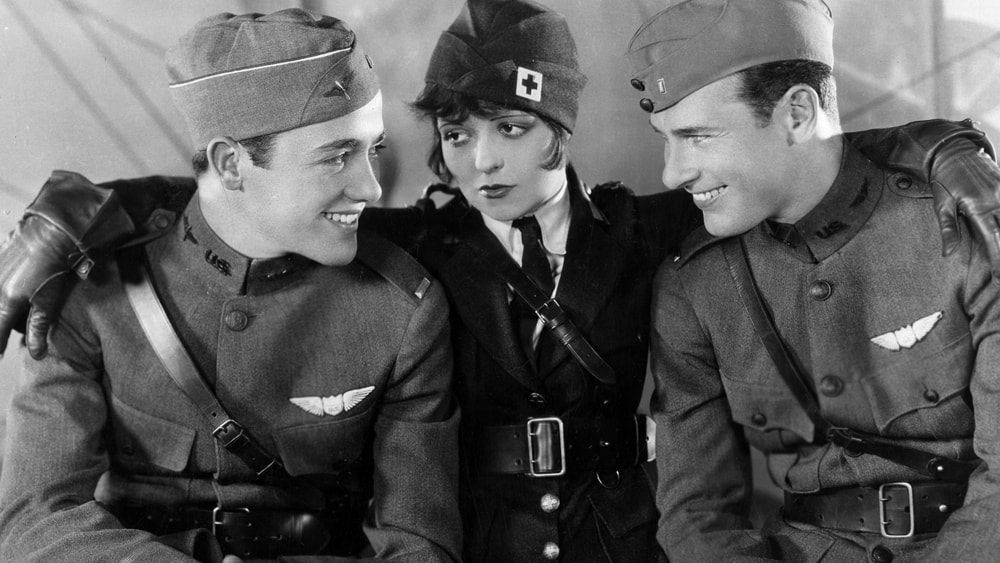 You can see why some thought 'Betty Boop' was based on Clara Bow... Enter the dramatic pilot death-faces. To a modern audience the most jarring element in all this is no doubt the over dramatic acting style, the melodrama, the prolonged deaths (zig-zag walking, flailing arms, ten seconds of woe is me and a collapse -rigid as a board). One such death even sees a soldier somersaulting down a mound which raises a chuckle and breaks the emotional connection to what was being seen on the screen. This is in contrast to moments where a much more realistic death might be portrayed and raise a lump in the throat. In one such a the soldier dies while sat on the roadside, cigarette in mouth. His comrade was unaware he had been killed and tries to rouse him unsuccessfully. The final shot of this scene is of said comrade rejoining the faceless ranks marching to the front line, having no choice but to leave his compatriots body in the ditch. I speculate that the contrast between these two ways of dealing with death may well have been to satisfy audiences more used to the large gestures, while introducing a reality they may well have been uncomfortable with. The director (a pilot) and many of those involved in the film had themselves fought in the war and certainly brought some of that with them. Overall an enlightening experience, a positive start and a re-affirmation of how quality transcends time. |
Previous ReviewsComing soon:Archives
February 2019
Categories
All
AuthorPablo Griffiths is a man with a passion for many things. He has recently taken an interest in writing about film, and himself in the third person. |
 RSS Feed
